|
The case for being a helpful kaypoh
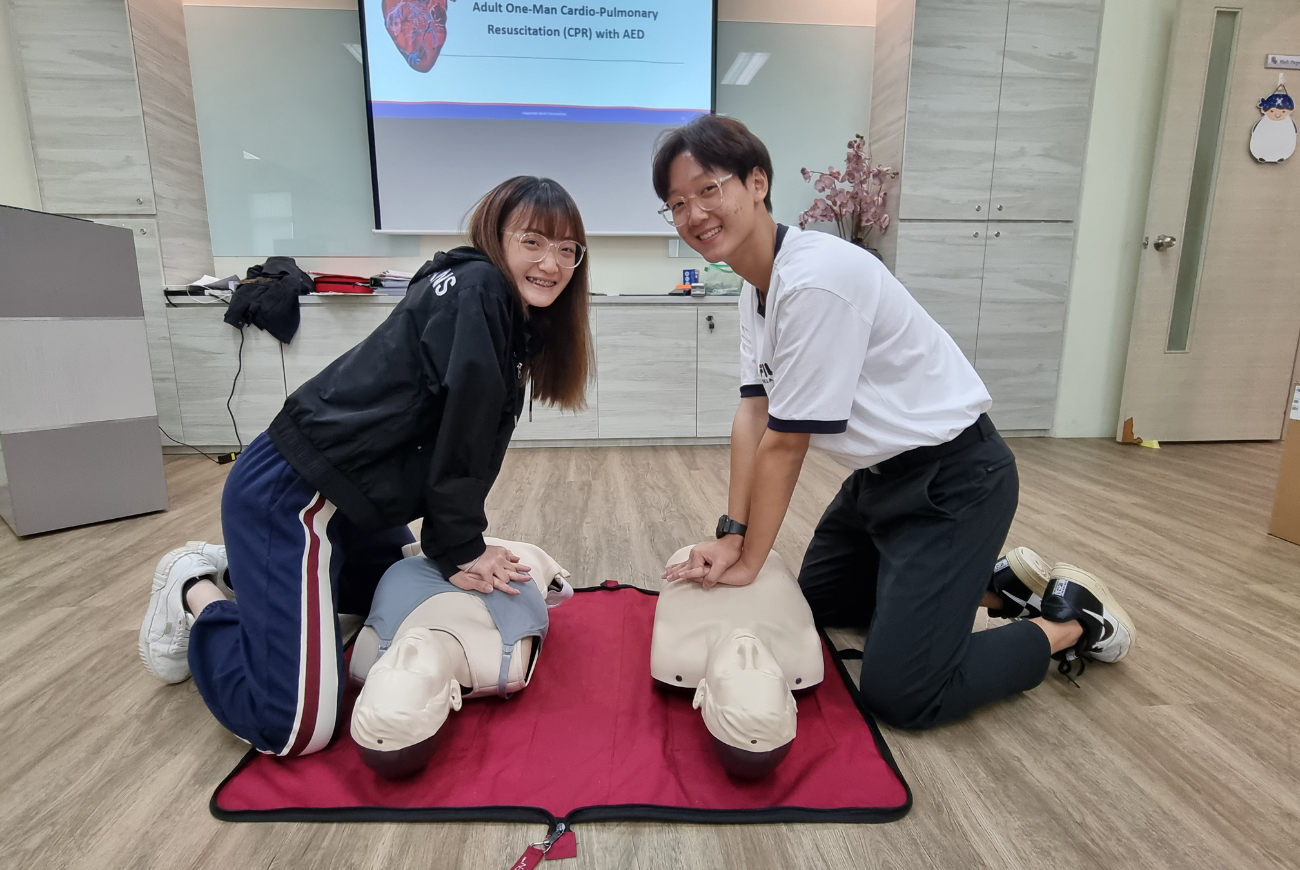
A conversation with community first responder Darryl Lee on fighting against time on living room floors, how to comfort a total stranger, and why it is good for everyone to learn lifesaving skills.
By Joanne Su
Unlike most youths his age, Darryl has seen death up close – 9 times to be precise. This is the number of cardiac arrest incidents the 17-year-old has attended since he signed up as a community first responder on the myResponder app in Nov 2020.
Armed with basic first aid knowledge he acquired in secondary school and a heart for people, he would take off immediately after receiving a notification about a case nearby.
“He is kaypoh like that since young lah,” his sister, Cheryl Lee, said laughingly, “in a good way.”
It was our pleasure talking to Cheryl and Darryl about his lifesaving experiences when they came to us in June to get certified in CPR+AED.
SHF: What are some memorable encounters from responding to 9 cases?
Darryl: There’s one particular case that hit me. It happened around 2.35am. When I arrived at the scene with the AED, the patient’s daughter was on the phone with the 995 call operator. Her eyes were teary, and her voice was very shaky. She was in a state of panic.
Her brother was doing chest compressions with the help of the operator. Immediately, I took over the chest compressions as instructed. He could only understand Malay, so we had a language barrier. I remember shouting instructions and having many conversations before the daughter got me a towel to protect the casualty’s modesty. By the time the AED delivered its first shot, the Emergency Medical Team had arrived.
After they took over, the daughter just looked on helplessly at her mother lying motionless on the floor. She broke down a few times and told me she was scared and worried — What if her mother didn’t make it? I felt very sad at that moment, and all I could do was comfort her and tell her to bring her [mother’s] NRIC and medication to the hospital so that she could show the doctors.
It must have been very traumatic. Was it common to see family members panic in the other cases you attended?
Darryl:Not really. In fact, there were a few cases where they called [995], but they didn’t do much; they just waited for help to come.
How can families better prepare themselves for medical emergencies?
I had not known about sudden cardiac arrest before I downloaded the (myResponder) app. Now I know cardiac arrest incidents that occur out of the hospital happen mostly in patients’ homes or public places. They can happen anytime, anywhere. They’re not breathing and their hearts are not beating, so they need urgent assistance.
Like I’ve seen, it can happen in the wee hours, so I think it would be good if at least one family member trained in basic CPR+AED in case, touch wood, anything were to happen. Early intervention can help them increase their survival rate.
What have both of you gained from today’s CPR+AED training?
Darryl: Today’s training was more realistic than the healthcare module I had taken. The manikin used here is very similar to an actual patient. It’s quite hard to compress and simulates a patient’s chest and rib. It also shows you where the blood is flowing when you are doing chest compressions.
A new thing I learned today was once you place an AED pad, you cannot remove it. Previously I thought it’s like a sticker, you can remove and put it back. But the instructor told me that the AED pad has a gel, so once you take it out, the gel might wear off and the pad is no longer usable.
Cheryl: Those who are interested to learn CPR should take this course. It gives you hands-on experience and you will be corrected on the spot if you are wrong.
Although you will not get 100% confidence immediately, I would say that I know what to do [to save a life] now.