|
The Salty Truth: How Salt Overconsumption Can Affect Your Health

Salt, specifically sodium chloride, is a common ingredient used to enhance the flavour of our meals. Known as “white gold” in the past, salt has been a highly sought-after commodity in human civilisation for thousands of years, extending beyond cooking to economic, cultural, and political realms. However, excessive salt consumption can harm our health. This article explores the effects of salt overconsumption, focusing on the context of Singapore, and highlights key statistics, sources of salt intake, and its associated health risks.
Salt Consumption in Singapore
Salt intake has been on the rise in Singapore, posing significant health challenges. According to the National Nutrition Survey in 2022, the daily sodium intake of the Singapore population increased from 3,480mg per day in 2019 to 3,620mg per day in 2022, far beyond the daily intake of 2,000mg recommended by the World Health Organization (WHO).1,2 Nine out of ten Singapore residents consume more than the daily recommended sodium intake of less than 2,000mg.1
Where Does the Salt Come From?
Understanding the sources of salt in our diet is crucial for addressing overconsumption. Sodium is naturally found in small quantities in all unprocessed foods. Over the years, Singaporeans have developed a taste for increasingly rich and salty foods. The main sources of sodium are added salt, sauces and seasonings used in cooking, especially in soupy dishes, gravies, and flavoured rice and noodles.1 Another source of added sodium is the salt added during the manufacturing of bread and noodles.1 Most of the salt intake comes from commercially prepared foods at restaurants and hawker centres, rather than from home cooking. Larger portion sizes, especially in eateries, also contribute to higher sodium consumption, exacerbating the problem.
How Much Sodium Do We Need?
Sodium is an essential nutrient for proper cellular function and maintaining fluid and electrolyte balance. It plays a crucial role in muscle and nerve cell function, as well as the transport of nutrients throughout the body. Sodium deficiency is rare in healthy individuals. It is estimated that we need less than 500mg of sodium per day (less than a quarter of a teaspoon of salt) to keep our bodies working properly.3 However, there is no convincing evidence that extremely low sodium intake reduces the cardiovascular risk and adverse outcomes. The World Health Organization currently recommends limiting sodium intake to less than 2,000 mg a day (equivalent to 5g or one teaspoon of salt per day), but most people consume much more sodium than necessary.4
The Dangers of Overconsumption of Salt
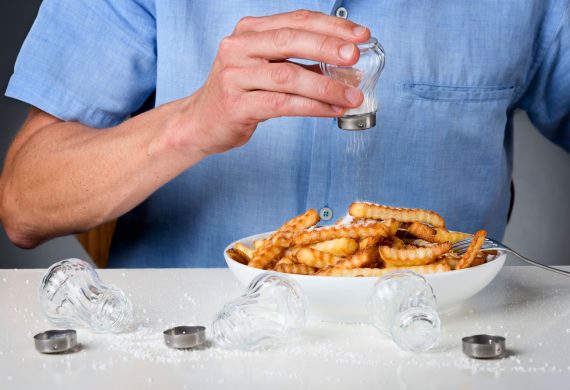
Eating too much salt can lead to several health problems. Prolonged high sodium intake can cause water retention and alter the functions of the kidney, heart, blood vessels and central nervous systems, leading to high blood pressure (hypertension) and cardiovascular disease such as heart attack and stroke.5–8 The WHO estimates that 1.89 million deaths each year globally are linked to excessive intake of sodium.4 Conversely, reducing sodium intake can lower blood pressure and decrease the risk of cardiovascular diseases.7,9,10
While the main health effect associated with a high sodium diet is raised blood pressure, there is a growing body of evidence that it can also lead to other health problems. Excess salt intake appears to increase the risk of stomach cancer,11 protein in the urine (proteinuria),12 kidney stones,13 osteoporosis,13 and Ménière’s disease.14 Some studies have linked increased sodium intake to headache15 and autoimmune diseases.16
How to Reduce Salt Overconsumption
The WHO aims to reduce global salt intake by 30% by 2025.4 To achieve this target, they recommend food manufacturers produce healthier, lower-salt foods and increasing consumer awareness about the risks of high salt consumption and healthier alternatives. In Singapore, one in four sauces and seasonings in retail is lower in sodium.17 Nine sauce suppliers and three salt suppliers provide lower-sodium ingredients to around 800 eateries, with more expected to join.17
To reduce salt intake, individuals can choose meals with less added salt, eat fresh unprocessed foods, read food labels to monitor sodium levels, and use herbs and spices instead of salt for flavouring dishes. The general public is encouraged to look for the “Lower in Sodium” Healthier Choice Symbol when buying ingredients and food products with at least 25% less sodium than similar products without the symbol.18 When cooking, herbs, spices, ingredients with naturally occurring glutamate such as mushrooms, and even lemon and garlic can be added to enhance the flavour of your dish in place of salt or seasonings.19 When dining out, patrons can reduce their sodium intake by avoiding gravies, sauces and soups as these tend to be high in sodium.20
Conclusion
High salt intake is associated with many diseases. Many food products contain salt, so one should be mindful of the salt content in their diet to avoid excessive consumption. The association between high salt intake and hypertension is well established, and it is best to limit salt consumption to the level recommended by the WHO. Public campaigns should increase awareness of the risks of high dietary salt and promote measures to adopt a healthier and more balanced diet.
Article is written by Clinical Assistant Professor Moy Wai Lun, Senior Consultant, Department of Internal Medicine, Sengkang General Hospital.
References
- Health Promotion Board Singapore. National Nutrition Survey 2022 Singapore.; 2022.
- World Health Organization. Guidelines: Sodium Intake for Adults and Children.; 2012.
- American Heart Association. How much sodium should I eat per day? 2024. Accessed July 27, 2024. https://www.heart.org/en/healthy-living/healthy-eating/eat-smart/sodium/how-much-sodium-should-i-eat-per-day
- World Health Organization. WHO Global Report on Sodium Intake Reduction.; 2023.
- Grillo A, Salvi L, Coruzzi P, Salvi P, Parati G. Sodium Intake and Hypertension. Nutrients. 2019;11(9). doi:10.3390/nu11091970
- Youssef GS. Salt and hypertension: current views. E-J Cardiol Pract. 2022;22(3). Accessed July 27, 2024. https://www.escardio.org/Journals/E-Journal-of-Cardiology-Practice/Volume-22/salt-and-hypertension-current-views
- He FJ, MacGregor GA. Salt, blood pressure and cardiovascular disease. Curr Opin Cardiol. 2007;22(4):298-305. doi:10.1097/HCO.0b013e32814f1d8c
- Ma Y, He FJ, Sun Q, et al. 24-Hour Urinary Sodium and Potassium Excretion and Cardiovascular Risk. N Engl J Med. 2022;386(3):252-263. doi:10.1056/NEJMoa2109794
- He F, Li J, MacGregor G. Effect of longer‐term modest salt reduction on blood pressure. Cochrane Database Syst Rev. 2013;(4). doi:10.1002/14651858.CD004937.pub2
- Williams B, Mancia G, Spiering W, et al. 2018 ESC/ESH Guidelines for the management of arterial hypertension: The Task Force for the management of arterial hypertension of the European Society of Cardiology and the European Society of Hypertension. J Hypertens. 2018;36(10):1953-2041. doi:10.1097/HJH.0000000000001940
- Joossens JV, Hill MJ, Elliott P, et al. Dietary salt, nitrate and stomach cancer mortality in 24 countries. European Cancer Prevention (ECP) and the INTERSALT Cooperative Research Group. Int J Epidemiol. 1996;25(3):494-504. doi:10.1093/ije/25.3.494
- Wright JA, Cavanaugh KL. Dietary sodium in chronic kidney disease: a comprehensive approach. Semin Dial. 2010;23(4):415-421. doi:10.1111/j.1525-139X.2010.00752.x
- Cappuccio FP, Kalaitzidis R, Duneclift S, Eastwood JB. Unravelling the links between calcium excretion, salt intake, hypertension, kidney stones and bone metabolism. J Nephrol. 2000;13(3):169-177.
- Yang X, Lin C, Wu Q, Li L, Mei X. Low-sodium diet with adequate water intake improved the clinical efficacy in Ménière’s disease. Acta Otolaryngol (Stockh). 2024;144(1):14-18. doi:10.1080/00016489.2024.2315302
- Amer M, Woodward M, Appel LJ. Effects of dietary sodium and the DASH diet on the occurrence of headaches: results from randomised multicentre DASH-Sodium clinical trial. BMJ Open. 2014;4(12):e006671. doi:10.1136/bmjopen-2014-006671
- Kleinewietfeld M, Manzel A, Titze J, et al. Sodium chloride drives autoimmune disease by the induction of pathogenic TH17 cells. Nature. 2013;496(7446):518-522. doi:10.1038/nature11868
- Ministry of Health. National Health Surveys Highlight Need to Focus On Healthy Diets and Lifestyles.; 2023. Accessed July 28, 2024. https://www.moh.gov.sg/news-highlights/details/national-health-surveys-highlight-need-to-focus-on-healthy-diets-and-lifestyles
- HealthHub. Two Easy Ways to Make Healthier Choice. December 1, 2022. Accessed July 28, 2024. https://www.healthhub.sg/live-healthy/halt-the-salt-sweetie
- Singapore Heart Foundation. 10 Flavourful Salt Substitutes. September 1, 2021. Accessed July 28, 2024. https://www.myheart.org.sg/heart-news/10-flavourful-salt-substitutes/
- Singapore Heart Foundation. Heart Healthy Dine Out Tips. https://www.myheart.org.sg/. 2022. Accessed July 28, 2024. https://www.myheart.org.sg/healthy-living/heart-healthy-dine-out-tips/