|
Does High Blood Cholesterol Run in Your Family?

Familial Hypercholesterolemia (FH) is the medical term for having an elevated level of low-density lipoprotein cholesterol (LDL-c or commonly known as the “bad” cholesterol) within the family. As the condition is inherited (passed down from parents), children are usually born with high blood cholesterol. The mode of genetic inheritance is often referred to as “autosomal dominant”, where each child of an affected parent has a 50% chance of inheriting this condition associated with very high blood cholesterol.

FH is Potentially Life-Threatening
Once thought to be rare, improved technology has accelerated the speed of detection: Prevalence of heterozygous (having one mutated copy) is 1 in 200-300, which translates to 16,667 to 27,500 individuals having FH in Singapore. Unfortunately, most people do not have any symptoms and often only realise that they have the condition when they suffer a heart attack. As it is silent, 9 in every 10 people with FH are unaware that they have this condition. Scientific research confirms that people with FH have a 20 times higher risk of heart attacks at a younger age (generally men before the age of 50 and women before 60 years old). In severe situations where the cholesterols are extremely high, heart attacks could even occur before age 20.
Signs and symptoms
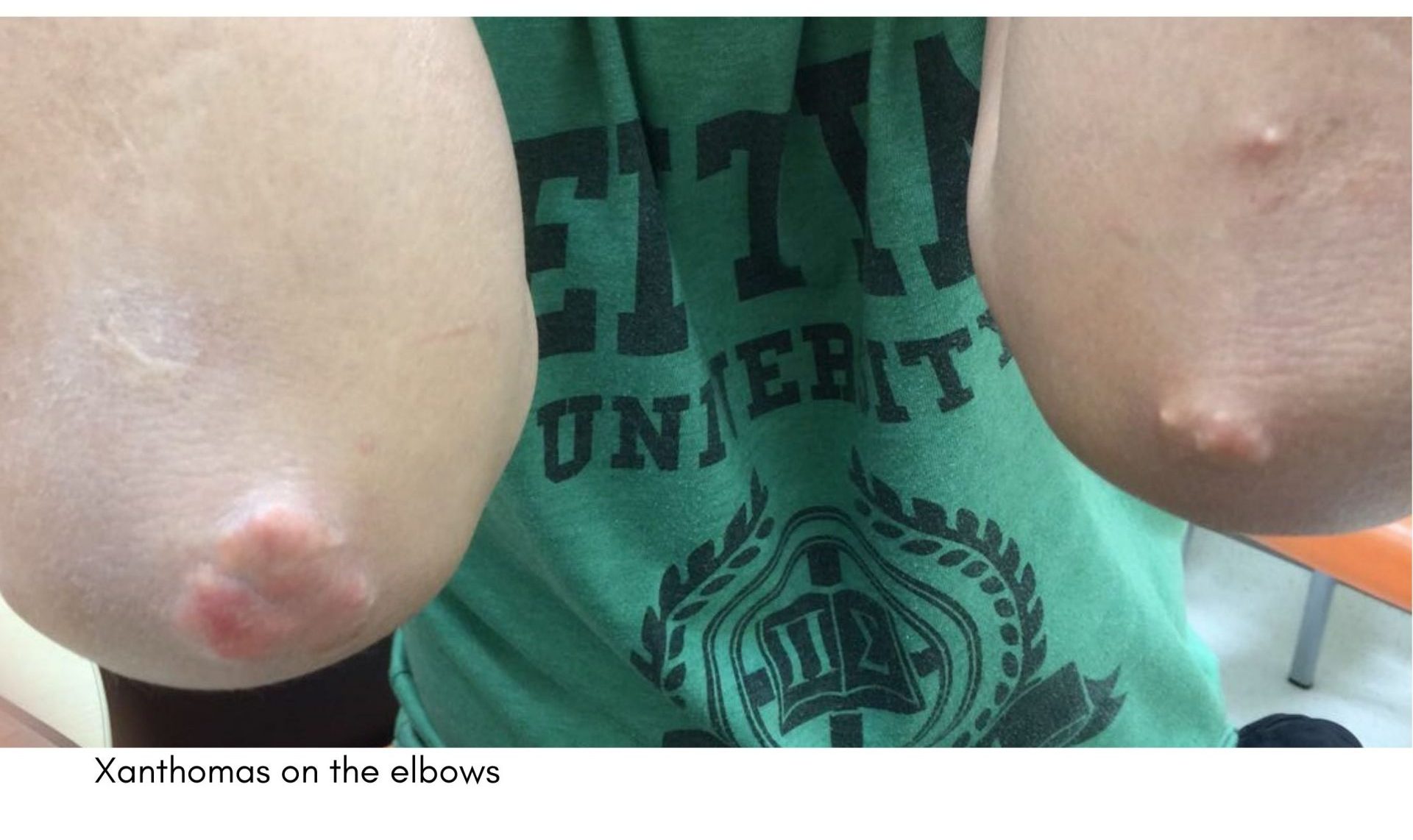
Most patients are asymptomatic (do not feel discomfort) until angina (chest pain) or a heart attack occurs. Xanthomas or arcus cornealis may be present in patients with FH, especially in those who are more severe like those with homozygous or compound heterozygous FH. Arcus cornealis is an arc to a full ring around the iris but does not influence vision. Xanthomas (fatty skin deposits) are cholesterol deposits and may regress in patients who are well treated. These signs are indicated by red arrows below with xanthomas on the elbows and arcus cornealis. Absence of these does not mean an individual does not have FH and a cholesterol test and/or DNA mutation test is necessary.

Treatment
Although genetic diseases have often been labelled as being “born with the trait”, FH can be easily treated. A combination of low cholesterol diet and medication allows patients to maintain LDL-c as low as that of the general population. For the best effect, medication has to begin as early as possible. Statins are the most commonly used pill for cholesterol lowering, with minimal side effects; while Ezetimibe are another class of medication to reduce LDL-c.
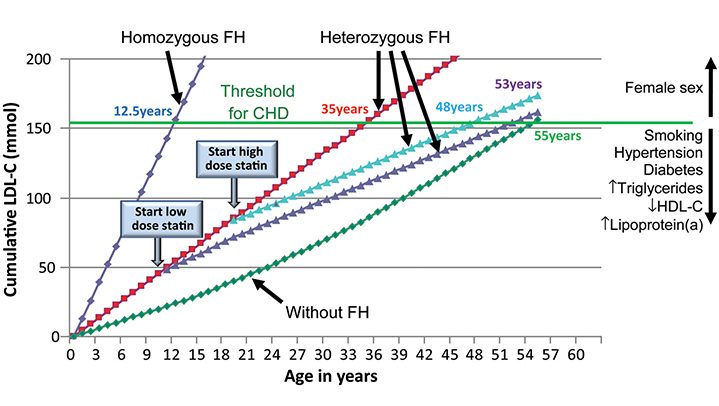
A typical patient with heterozygous FH (red line), when treated early and intensively (light blue and purple lines), will present with a lowered risk, similar to that of the general population (green line).
It is extremely important that patients with FH continue to monitor other risk factors of heart attacks. Smoking, hypertension, diabetes, high triglycerides, low HDL-c and high Lipoprotein(a) all increase the risk for heart attacks substantially and patients with FH should try to improve these parameters to reduce their risk, in addition to the reduction of LDL-c.
Cascade Screening
The most cost effective way of identifying new patients is through cascade screening. When the first patient (known as index patient or proband) is found to have FH, their first-degree relatives will be screened for cholesterols and/or mutation. First-degree relatives usually have a 50% chance of inheriting the same condition. This format will continue until all members in the family pedigree have been screened. When found to have high LDL-c and presence of pathogenic mutation, treatment should be initiated as early as possible, similar to index cases.
FHCARE Programme
The FHCARE programme was initiated in 2015 by Khoo Teck Puat Hospital, in collaboration with the National Heart Centre Singapore, National University Hospital Singapore, KK Women’s and Children’s Hospital, Singapore General Hospital, Changi General Hospital, Tan Tock Seng Hospital, Seng Kang Hospital and National Healthcare Group Polyclinics. This programme aims to increase awareness of FH and to reduce the number of undiagnosed FH and to improve the care of families with FH.
Credit also goes to the Singapore Heart Foundation (SHF) and Alexandra Health Fund (AHF) for supporting the research study and various public awareness efforts.
If you think you have FH or suspect that your loved ones have the condition and would like to get more information or join the study, please contact the study team at
Hotline: 6602 2346
Email: cholesterol.info@ktph.com.sg
Contributed by Dr Sharon Pek, Principal Research Officer from Khoo Teck Puat Hospital and Associate Professor Tavintharan Subramaniam, Director and Senior Consultant from Admiralty Medical Centre.