|
Resilience Despite Breathing Challenges
by Lim Hwei Shuean
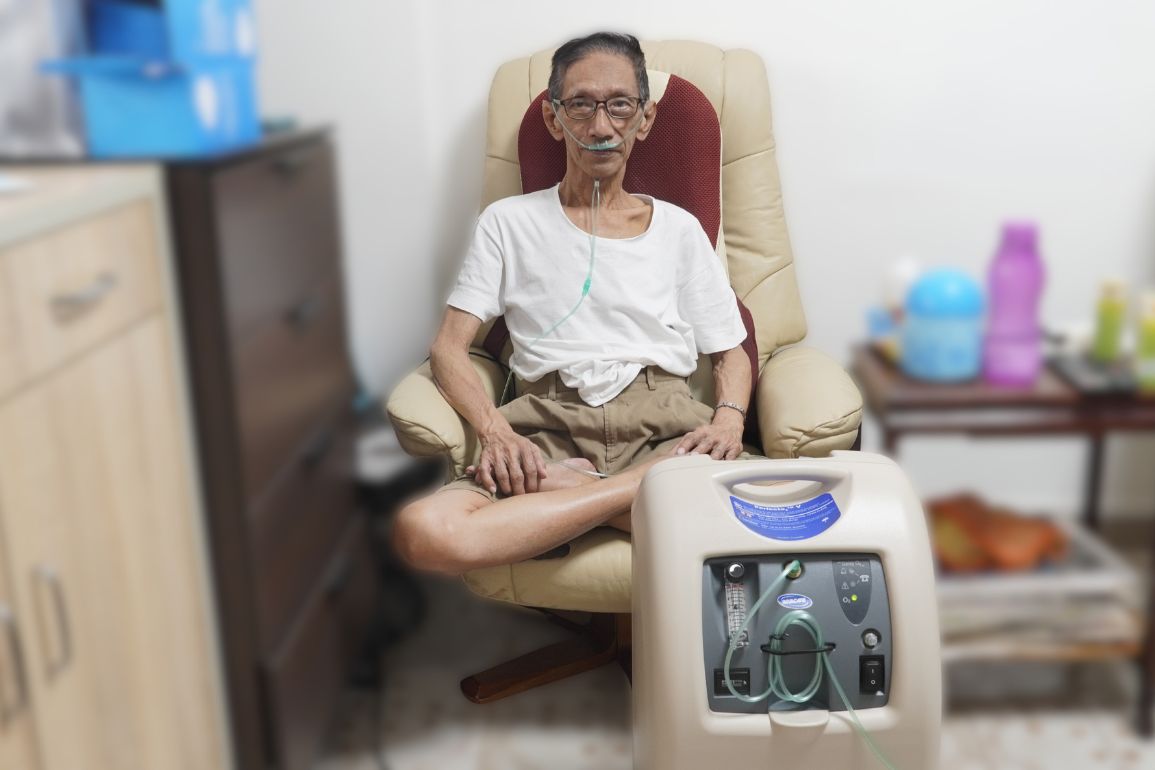
The average person does not think twice about the process of breathing, as it comes naturally to the individual. Mr Seah requires physical support in breathing. 72-year-old Mr Seah uses an oxygen concentrator almost 24 hours a day to help him breath. The former qigong master has spent years imparting his skills, and the calm that he has mastered has helped him maintain a positive outlook on life, despite his current affliction.
A condition discovered
It was routine for Mr Seah when he experienced shortness of breath. Even a short walk from the living room to the toilet in his 3-room flat would leave him breathless. He decided to consult the doctor at the clinic near his home. The doctor found that Mr Seah had elevated blood pressure, and he suspected that it could be a heart condition. He immediately referred Mr Seah to the hospital.
At the end of 2019, after a series of checkups that spanned over five days, the doctors discovered that Mr Seah was suffering from pulmonary hypertension, an extremely rare medical condition that affects about 2 to 10 persons per million people in a year. This condition is a blockage of the pulmonary artery – the artery that carries blood from the heart to the lungs. As a result, the flow of oxygenated blood to the lungs is obstructed, hence causing a shortness of breath.
During his stay in the hospital, Mr Seah was put on an oxygen concentrator to alleviate his breathing. When he was discharged, he reached out to a social worker at the hospital, to secure vital information on an oxygen concentrator that he could use at home. He managed to buy one at a subsidised cost, which he could afford.
A crisis emerges
About a year and a half later, the oxygen concentrator showed signs that it needed repair. Its indicator flickered from its usual green, to yellow and to red; it beeped whenever it turned on, and it radiated heat. As the three-year subsidy contract for the concentrator was still in effect, Mr Seah could not have it replaced. He had to make do with constantly turning the oxygen concentrator on and off, in five-minute intervals; this was a temporary solution to ensure its function.
Mr Seah needed a conclusive solution, but he did not have the financial means. He contacted his medical social worker who helped him meet the cost for repairs through the Singapore Heart Foundation’s Heart Support Fund. Unfortunately, the pandemic saw a surge in demand for the oxygen concentrator’s spare parts, and Mr Seah had to wait half a year before he could obtain a newly repaired oxygen concentrator.
A new life
The oxygen concentrator continues to serve him till today in 2024.
In the day, he relies on his motorised scooter to travel out for meals, to enjoy the sun, and to get him to his workplace where he is a part-time receptionist. At the end of every day, he returns to his oxygen concentrator to ensure that he does not overexert and that he continues breathing normally.
Despite the fact that being on the oxygen concentrator restricts his mobility, Mr Seah lives his life to the fullest. “It’s like I don’t have enough time in the day because time passes so fast!”, he beams.
Help support heart patients like Mr Seah. Please visit https://www.myheart.org.sg/donate/ for more information.