|
How to Perform CPR+AED for Women
Around 3,000 out-of-hospital cardiac arrests occur in Singapore every year, and one-third of the casualties are women. Unfortunately, women are less likely to receive timely CPR+AED because many men are afraid that they will be accused of molestation or sexual assault if they touch a woman’s breasts or injure her, especially when she is a stranger.
But with every minute that nothing is done to resuscitate the casualty, chances of survival drop by 10%. So, do not hesitate. Just remember DRS ABC.
The administration of CPR and AED does not differ between men and women; the steps to take are the same.
Check for Danger
Ensure that the surrounding is safe for you to approach the casualty.
Check for Response
Tap firmly on the casualty’s shoulders, and ask, “Hello hello, are you ok?”
Shout for Help
Ask someone to call 995 for an ambulance. You can also use the myResponder app to dial 995 and send your geolocation directly to the Singapore Civil Defence Force (SCDF) for faster dispatch of emergency resources to the scene.
Put your phone on speaker mode and follow the SCDF dispatcher’s instructions.
Ask for an AED
Ask someone to get an AED. The myResponder app also shows you where to locate the nearest AEDs.
To retrieve the AED from the cabinet, use a solid or sharp object like a key or pen and strike confidently at the centre of the glass on the AED cabinet to break it and retrieve the key. Do not use your bare hands.
Check for Breathing
Look for the rise and fall of the casualty’s chest.
Early CPR
If the casualty is not breathing, breathing abnormally, or when you are in doubt, start CPR immediately. For every minute that nothing is done to resuscitate the victim, the chance of survival drops by 10%.
Follow these steps for chest compressions*:
- Kneel with knees slightly apart.
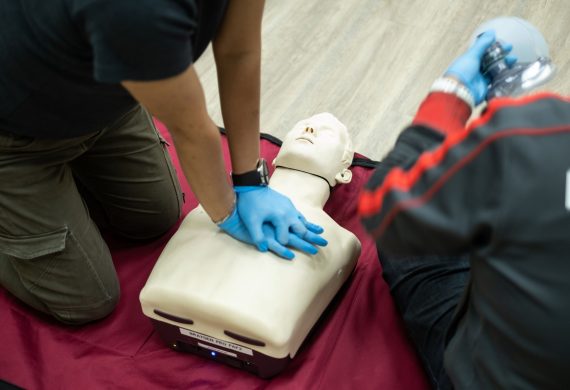
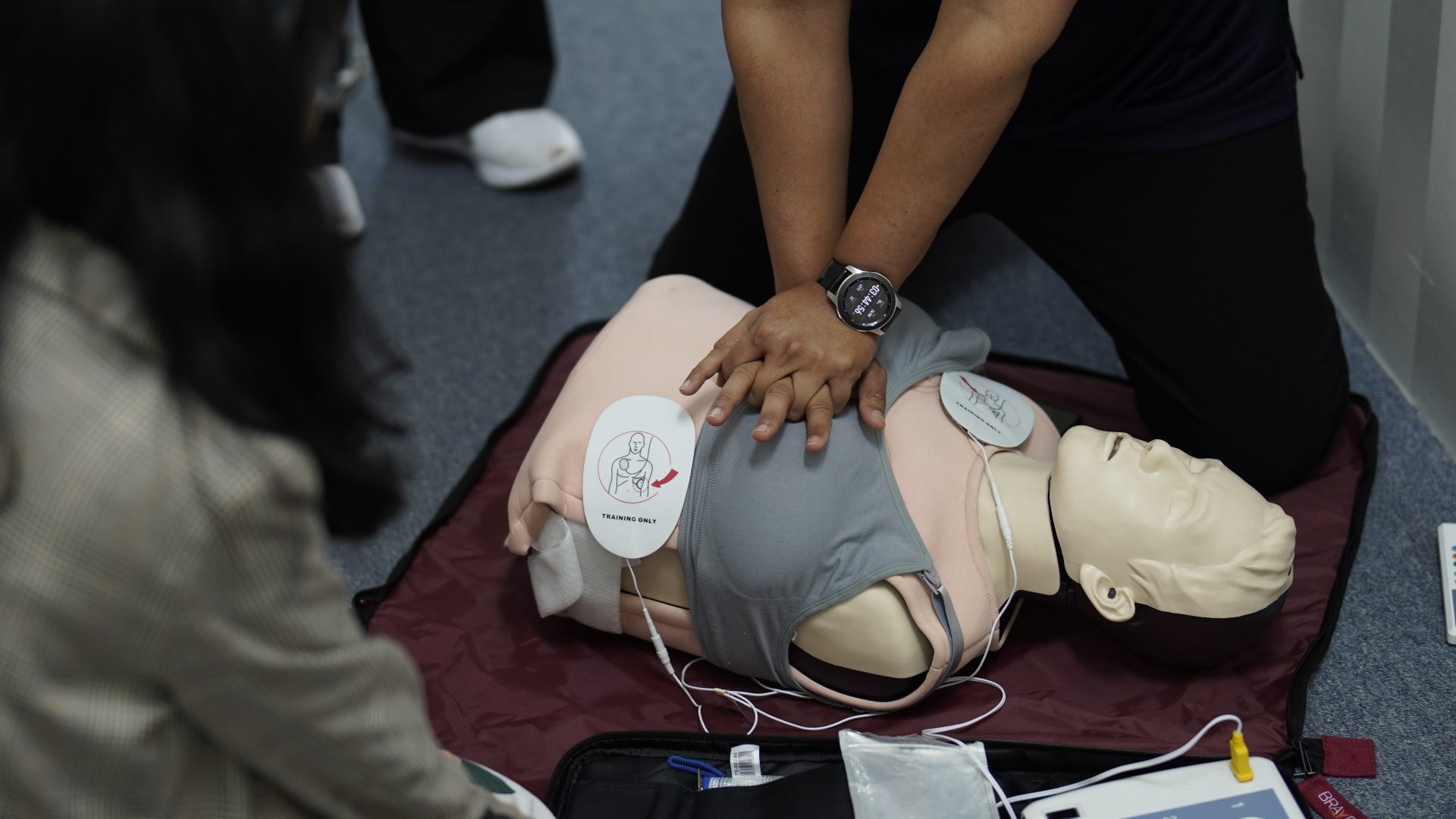
- Place the heel of one hand on the lower half of the breastbone (sternum). Place the heel of the other hand on top of the first hand and interlace your fingers. You can lift your palm off the breast to avoid pressing on the breasts. Position your shoulders directly over the casualty’s chest. Straighten both elbows and lock them in position.
- Compress with the heel of your palm. Use bodyweight to achieve a compression depth of 4-6cm and compress a rate of 100 to 120 times per minute. The chest should fully recoil (comes up all the way) after each compression.

When the AED arrives, follow these steps:
-
- Use the AED in a safe environment.
Check the area to ensure there is no wet or metallic surface or flammable gas.
Always continue CPR until the AED is ready for analysis.
-
- Turn on the AED and follow the voice prompt.
Before using the AED, cut along the side of the casualty’s shirt and pull up her bra. Cut the bra if it obstructs the placement of the AED pads.
-
- Place the AED electrode pads.
Place one electrode pad on the casualty’s upper right chest (anterior) under the collarbone, and the other electrode pad on the lower left side (lateral) under her left breast.
You can cover her up with her shirt after the AED pads are placed to protect her modesty.
If there are other people around, we can also get them to form a human shield, facing outwards, to block the view of passers-by.
-
- AED analysing.
When the AED starts analysing heart rhythm, no one should touch the casualty. Spread both arms out and shout “Stay Clear”.
-
- When the AED prompts:
Shock advised
|
No shock advised Resume chest compressions and follow the AED prompts. |
Stop CPR only when the AED is analysing heart rhythm, when the casualty wakes up or regains normal breathing, or when the paramedics take over.

Is the underwire of the bra safe for AED?
So far, there is no local research to show that the underwire of a bra will create an electric short circuit or re-route the electric current. An exposed underwire bra may cause a localised burn on the casualty’s skin, but this is a rare scenario as there is usually fabric around the underwire.
During an emergency, the priority should be to provide quality chest compressions and operate the AED in a safe environment (ensure free of water, flammable materials and metallic surfaces).
*Please note that the tips provided are non-exhaustive.
Here’s a video to guide you through CPR+AED: