|
Out-of-Hospital Cardiac Arrest Statistics

Sudden cardiac arrest is a heart condition that strikes without warning. It occurs when the heart malfunctions and stops beating unexpectedly. The person loses consciousness and has no pulse. While helpless, they are not always hopeless. Survival is possible if bystanders help provide immediate chest compressions and use an AED.
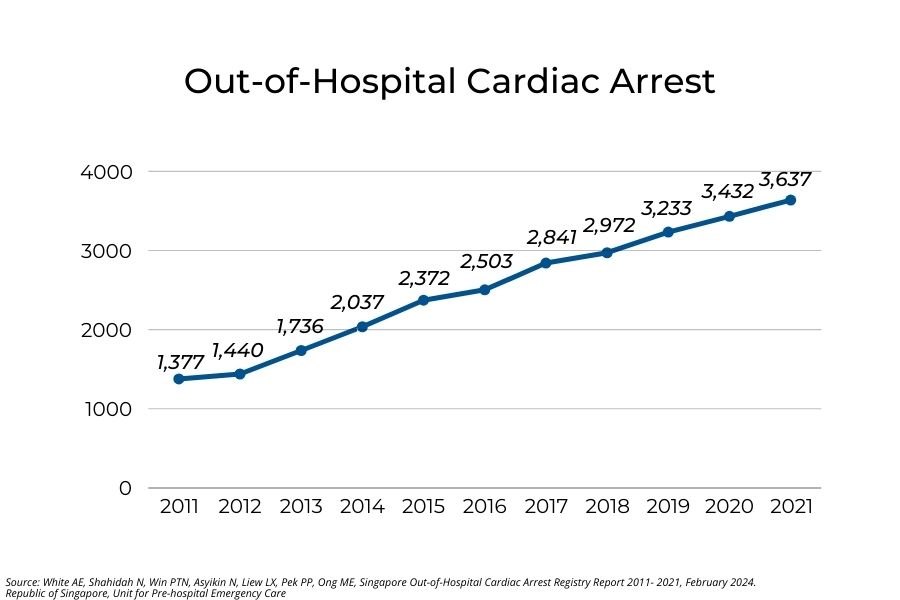
In Singapore, more than 3,000 people suffer from sudden cardiac arrest every year, with close to 80% in residential and public settings, i.e., outside healthcare facilities. Here, we track the out-of-hospital cardiac arrest situation in Singapore with data from the Unit for Pre-hospital Emergency Care (UPEC).
Highlights from the Singapore’s Out-of-Hospital Cardiac Arrest Data Report (2011-2021)
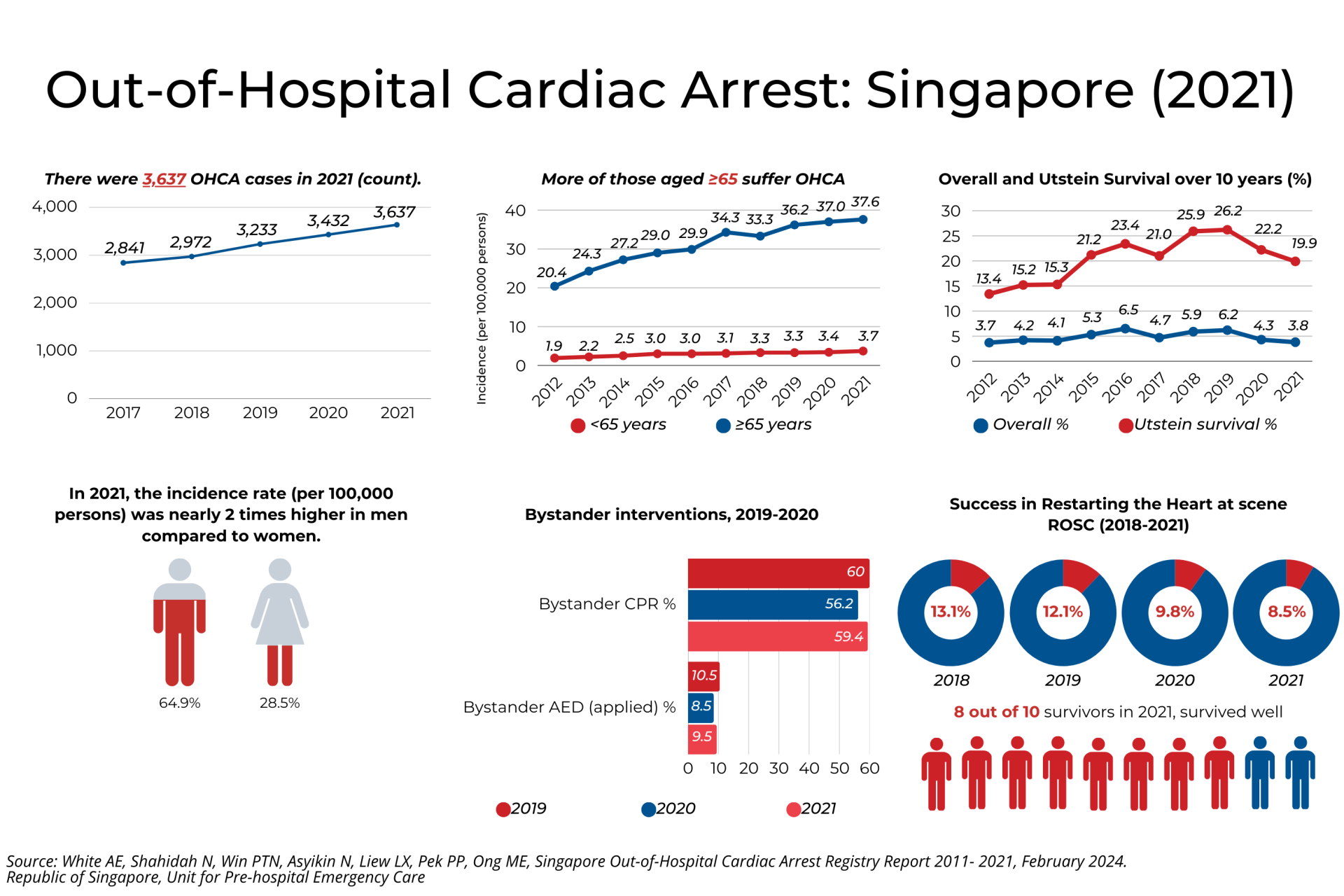
- Out-of-hospital cardiac arrest cases have increased from 3,432 in 2020 to 3,637 in 2021.
This increase is due to the growing proportion of the elderly population in Singapore. Age is a major risk factor for cardiac arrest.
- Bystander CPR rates increased from 56.2% in 2020 to 59.4% in 2021.
- AED applied/used rates rose slightly from 8.5% in 2020 to 9.5% in 2021.
We suspect that this slight tick upwards could be the beginning of an anticipated bouncing back from measures taken during the COVID-19 response (including momentary pausing of the myResponder app), which brought down the AED use rate. As before, the bystander AED use rate is a critical indicator to watch because early use of AEDs can more than double the survival rate. - Return of Spontaneous Circulation (ROSC) at scene/en route decreased to 8.5% from 9.8% in 2020 marking 3 years of decreasing rates.
ROSC is another important indicator to monitor because it is an initial, but unstable, state of recovery. - Number of people who survived-to-discharge in 2021 was 140 compared to 149 in 2020.
The overall OHCA survival-to-discharge rate decreased to 3.8% in 2021 from 4.3% in 2020.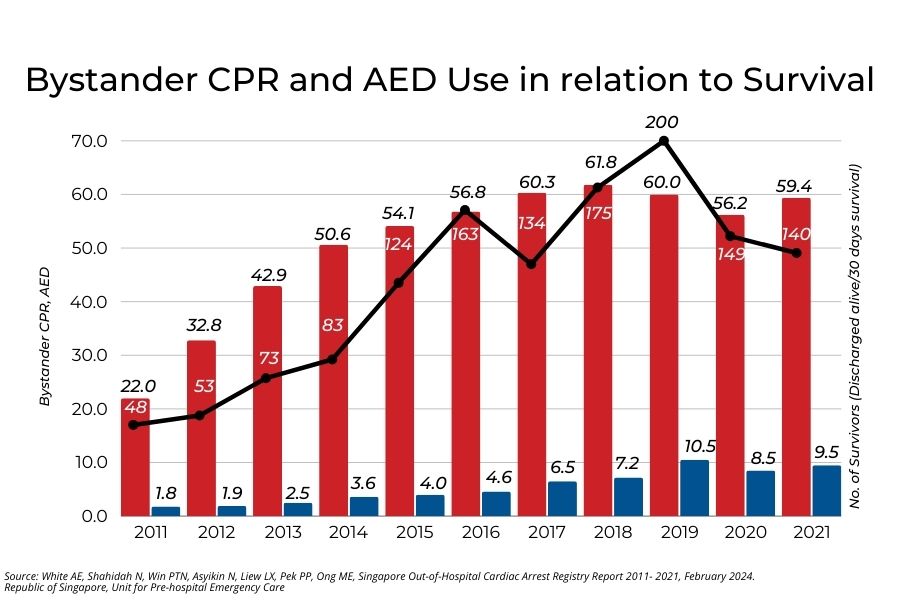
- Utstein survival fell to 19.9% in 2021, down from 22.2% in 2020.
The Utstein survival rate is an internationally accepted benchmark measure to monitor how well we are doing with our overall efforts to improve the entire chain of survival. - 79.3% of OHCA survivors had good-to-moderate neurological function compared to 73.8% in 2020.
Survival-to-discharge with good-to-moderate neurological functioning is the gold standard for OHCA survival.
While our survival rates are dipping, those who are surviving, survive well.
More statistics are in the full report.
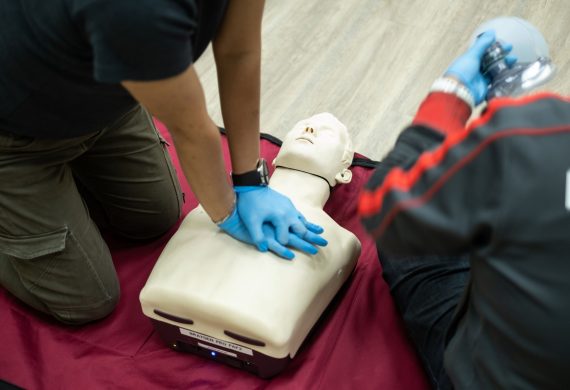
Immediate application of CPR and AED can increase a victim’s survival rates by as high as 50%.
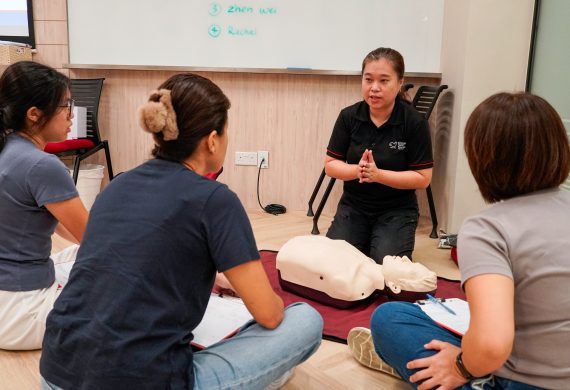
You do not need to be trained or certified to perform CPR or use an AED. But taking a course will give you the confidence to spring into action immediately during an emergency.


Sign up for a course