|
How To Perform CPR: Steps and Procedure
Cardiac arrest is a critical medical emergency, and the application of cardiopulmonary resuscitation (CPR) and automated external defibrillator (AED) can dramatically increase survival rates. Around 3,000 out-of-hospital cardiac arrests (OHCA) occur in Singapore every year, with 70%–80% happening either at home or in public places. Prompt CPR and AED intervention can significantly improve outcomes during the golden hour before emergency services arrive. Here’s a comprehensive guide on how to perform CPR effectively.
When To Perform CPR
CPR should be administered to cardiac arrest victims who are unresponsive and not breathing or exhibiting abnormal breathing. If in doubt, check for signs of breathing by observing the person’s chest. Cardiac arrest differs from a heart attack, though both are life-threatening and require immediate action.
If you notice someone who needs help, do not panic. Just remember DRSABC.
CPR How To for Adults
D – Check for Danger
Ensure that the surrounding is safe before approaching the casualty.
R – Check for Response
Tap firmly on the casualty’s shoulders and ask, “Hello! Hello! Are you ok?”
S – Shout for Help
Ask someone to call 995 for an ambulance. You can also use the myResponder app to dial 995 and send your geolocation directly to the Singapore Civil Defence Force (SCDF) for faster dispatch of emergency resources to the scene.
Put your phone on speaker mode and follow the SCDF dispatcher’s instructions.
A – Ask for an AED
Ask someone to get an AED. The myResponder app also shows you where to locate the nearest AEDs.
To retrieve the AED from the cabinet, use a solid or sharp object like a key or pen and strike confidently at the centre of the glass where the key was kept and retrieve the key. Do not use your bare hands.
B – Check for Breathing
Look for the rise and fall of the casualty’s chest for not more than 10 seconds.
C – Early CPR
Begin chest compressions if the casualty is not breathing, breathing abnormally, or when you are in doubt. For every minute that nothing is done to resuscitate the victim, the chance of survival drops by 10%.
For CPR to be effective, the casualty needs to be placed on their back, on a firm, flat surface.
Steps for Chest Compressions
Follow these steps for chest compressions*:
- Kneel beside the casualty with knees slightly apart.
- Interlace fingers.
- Place the heel of your hand on the lower half of the sternum (breastbone).
- Position your shoulders directly over the casualty’s chest.
- Straighten both elbows and lock them in position.
- Use your body weight to achieve a compression depth of 4 – 6cm and compress at a rate of 100 – 120 compressions per minute. The chest should fully recoil (comes up all the way) after each compression.
Steps to use AED
- Use the AED in a safe environment.
Ensure the area is dry and free of metallic surface or flammable gas. Always continue CPR until the AED is ready for analysis. - Turn on the AED and follow the voice prompt.
Put on your gloves, shift any jewellery on the casualty’s body to the side. Roll up the casualty’s shirt and shave any chest hair. Remove medical patches, and wipe dry the chest. Ensure the chest is bare, dry and clean. - Place the AED electrode pads.
Apply AED pads firmly to the bare chest according to the diagram: one on the upper right chest under the collarbone and the other on the lower left below his left nipple. If the casualty has a pacemaker, you have to place the AED pad four fingers away from it. - AED analysing.
When the AED starts analysing heart rhythm, no one should touch the casualty. Spread both arms out and shout “Stay Clear”. - When the AED prompts:
- Shock advised
Shout “Stay Clear”. Ensure no one is touching the casualty before pressing the shock button. After shock is applied, resume chest compressions, and follow the AED prompts. - No shock advised
Resume chest compressions and follow the AED prompts.
- Shock advised
When to Stop CPR
Perform uninterrupted chest compressions until:
- The AED prompts you to stop.
- The casualty begins to breathe normally. Do not leave the casualty unattended and monitor them closely as they may stop breathing suddenly.
- Paramedics are ready to take over.
- You are too exhausted to continue (if alone), though rest should be no more than 10 seconds (preferably after 100 compressions). If two rescuers are present, take turns to perform chest compressions every two minutes. There should be minimal interruption to the chest compressions during the changeover.
CPR How To For Infants
Although it is rare for an infant below 1 year old to suffer from a cardiac arrest due to heart disease, it could happen due to traumatic injury or accident, e.g., traffic accident, drowning or choking. If you notice that an infant is not breathing, has abnormal breathing, or is unconscious, do not panic. Just like performing CPR+AED on an adult, follow the steps DRSABC.
D – Check for Danger
Ensure that the surrounding is safe before aprroaching the casualty.
R – Check for Response
Tap the infant firmly on his/her shoulder to elicit a response. Avoid shaking violently to prevent injury.
S – Shout for Help
Call 995 for an ambulance and follow the dispatcher’s instructions.
A – Ask for an AED
Ask someone to get an AED with pediatric pads, if available.
B – Check for Breathing
Look for the rise and fall of the casualty’s chest for not more than 10 seconds.
C – Early CPR
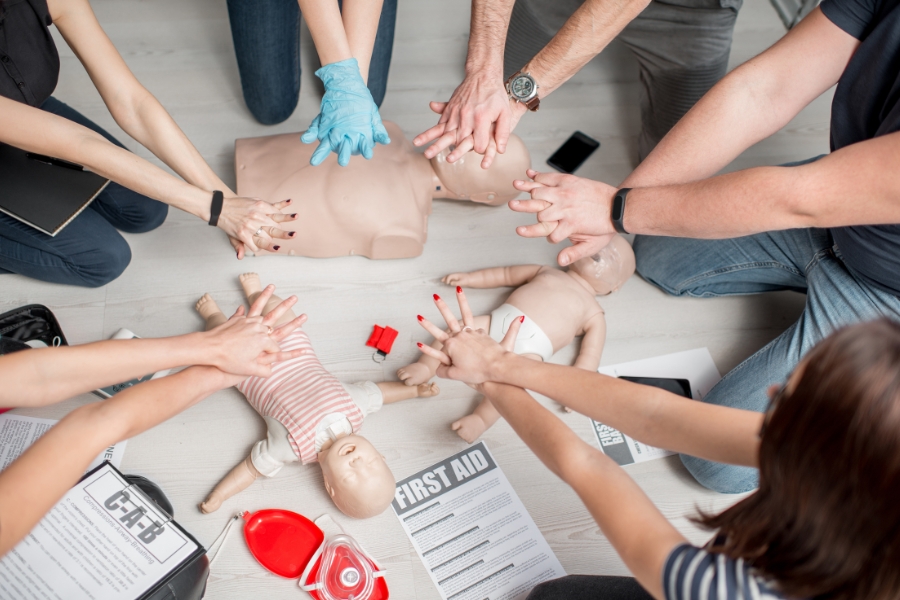
Place the infant on a firm, flat surface and locate the sternum for chest compressions.

Steps for Chest Compressions
- Use your index finger to draw an imaginary line between the nipples to the centre of the sternum.
- Place your middle (third) and ring (fourth) fingers next to your index finger in an upright position.
- Lift your index finger but maintain the middle and ring fingers on the sternum and perform 30 chest compressions. Compress 100 to 120 times per minute, at a depth of 3 to 4cm.
Mouth-to-Mouth and Nose Ventilations
After 30 compressions, open the airway and perform mouth-to-mouth and nose ventilations.
- Put one hand on the infant’s forehead and gently lift the chin. Do not hyper-extend the infant’s airway.
- Make a tight seal by placing your mouth over the infant’s mouth and nose.
- Give 2 quick breaths, each lasting about 1 second, watching for chest rise.
- Continue with 30 compressions and 2 rescue breaths until help arrives or normal breathing returns.
- If the infant resumes breathing, place him/her in a lateral position or carry him/her till help arrives. Do not leave the infant unattended.
How To Get Certified
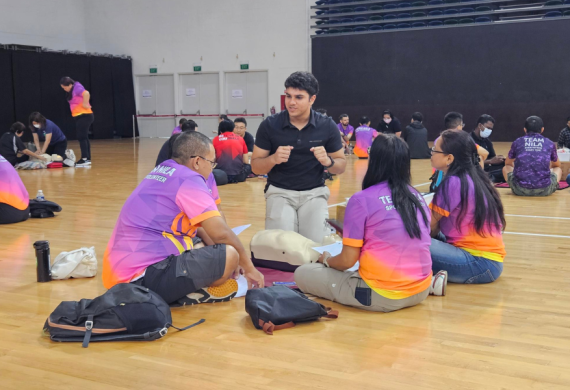
While you can perform CPR without formal training, having CPR training, including the use of an AED, enhances the chances of saving a life.
Sign up for:
- CPR+AED certification course – Focuses on hands-only CPR and AED on Adult Casualty
- Basic Cardiac Life Saving and AED certification course – Includes mouth-to-mouth ventilation and Infant CPR techniques
These certifications are invaluable for anyone, providing the knowledge to act effectively in emergencies. Still unsure which one to take? Check out our guide here!
Conclusion
Knowing how to perform CPR can save lives. Immediate and effective CPR keeps oxygen-rich blood flowing to the brain and other vital organs, reducing the risk of brain damage. Understanding how to use an AED is equally crucial as it helps restore the heart’s normal rhythm. With proper training and knowledge, you can make a significant difference in a life-threatening situation. Remember, your prompt actions can be the key to survival in cardiac arrest emergencies.