|
Mental Well-Being and Atrial Fibrillation

In recent years, there has been greater recognition of significant interactions between the heart and the brain. A common condition that affects both the heart and brain is atrial fibrillation (AF). AF is a condition where the heart loses its regular rhythm and becomes irregular.
The irregularity can be felt in the wrist pulse. AF is more common in older age groups and in an ageing nation such as Singapore, more patients are expected to be diagnosed with AF in the future. It is predicted that in the next 50 years, the number of AF patients will double.
The consequences of AF are profound and serious.
- Symptoms such as palpitations, breathlessness, chest pain and lightheadedness happen due to the rapid, irregular pulse
- Increases the patient’s risk of developing a stroke by more than 500%. The atria cannot contract fully, leading to stagnation of blood and formation of large blood clots. When these blood clots leave the heart, there is a chance that they can travel and lodge in one of the arteries supplying part of the brain, causing a stroke. Stroke caused by AF is more likely to cause major handicap and/or dementia
- Increases the risk of overall mortality by 200% and risk of heart failure by 300%
- Worsens any pre-existing heart condition such as heart failure, coronary artery disease
- Increases chance of being admitted to the hospital by 200%
- Very expensive to treat, with the cost of managing this disease exceeding US$30 billion in the United States each year
The connection between AF and mental health
What has been under-appreciated is the effect of AF on mental well-being. In a survey of 152 AF patients using a validated Quality of Life questionnaire, AF patients had poorer mental health status compared to healthy subjects, patients with heart failure or even those who have experienced a heart attack.
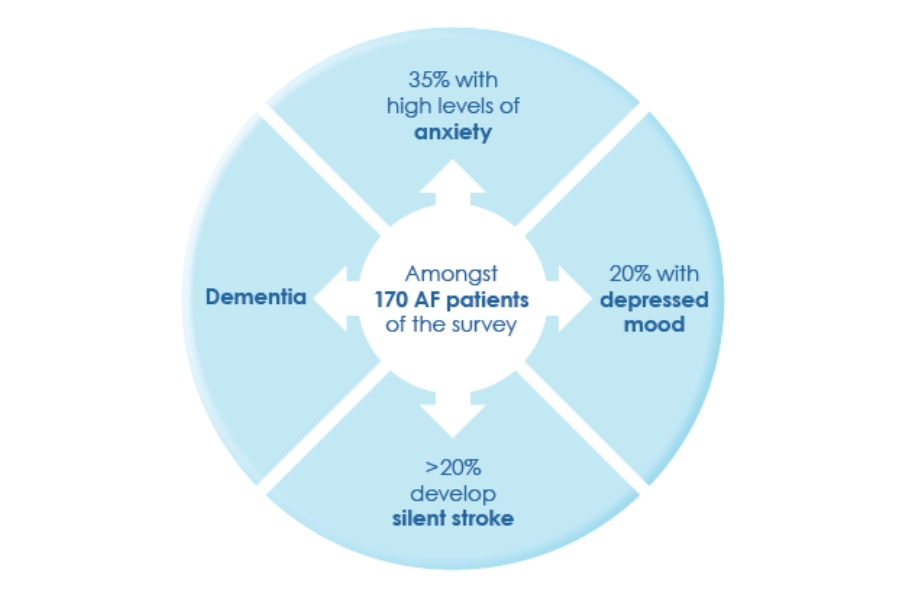
Psychological distress including anxiety, depression and preoccupation with their symptoms is high amongst AF patients, perhaps as much as 50%. Amongst 170 AF patients, 35% of patients reported high levels of anxiety and 20% with depressed mood. In a vicious cycle, anxious AF patients are more likely to develop AF recurrence after treatments.
It is also recognised even when AF patients are well managed with blood thinners to minimise the risk of stroke, more than 20% of patients will develop silent stroke, which results in lower cognitive function over time.
In the longer term, such deterioration in cognitive function leads to dementia, and AF patients are much more likely to develop dementia compared to non-AF patients, even in the absence of stroke.
The onset of dementia further worsens mental health status.
Treatment and prevention
Encouragingly, over the past 20 years, excellent treatment options have become available for AF patients.
These include safer blood thinners, known as direct-acting oral anti-coagulants (DOAC) to minimise the risk of stroke, and the increasing accessibility to catheter ablation (a procedure where the heart rhythm specialist (cardiac electrophysiologist) inserts a catheter into the heart through the veins of the leg, and uses it to correct the abnormal electrical activity), a minimally invasive treatment that can stop AF recurring in more than 80% of early onset AF patients.
Compared to heart rhythm medications, ablation therapy is significantly more effective in maintaining normal heart rhythm and this, in turn, reduces the risk of stroke and improves the quality of life. In a nationwide study of more than 194,000 Korean patients who had catheter ablation, they were 27% less likely to develop dementia.
It is also proven that AF can be prevented with healthy lifestyles and a work-life balance.

Prospective data from Europe shows that long working hours (defined as more than 55 hours per week) and high job strain for more than 10 years increase the risk of AF by about 40%.
AF is a major, preventable heart rhythm disturbance, associated with significant mental health impairment such as anxiety, depressed mood and in the longer term, dementia. These symptoms are common and should be addressed as part of a holistic care programme for AF. Restoring normal heart rhythm combined with appropriate use of anti-coagulants is the best strategy to improve mental quality of life and reduce the risk of stroke and dementia.
Tips:
- Manage blood pressure
- Maintain a healthy weight
- Reduce alcohol consumption – 2 servings for men and 1 serving for women daily
- Exercise regularly – 150-300 minutes of moderate-intensity aerobic exercise a week
- Work-life balance – Clock less than 55 hours per week and maintain a low job strain
Article is contributed by Dr Pipin Kojodjojo, a Consultant Cardiac Electrophysiologist at Asian Heart & Vascular Centre.