|
AED Pad Placement Guide: The Correct Way To Put AED Pads

Automated external defibrillator pads (AED pads) are a vital part of any automated external defibrillator (AED) and are needed for successful defibrillation of cardiac arrest victims. When the AED pads are placed on the bare chest of a sudden cardiac arrest victim, the AED is able to detect and treat life-threatening and irregular heart rhythms known as Ventricular Fibrillation (VF). The electrical shock delivered by the AED through the chest allows a regular rhythm to resume in the heart.
Accurate AED pad placement contributes to the survival chances of the cardiac arrest victim. In a sudden cardiac arrest emergency, AED electrode pads should be applied swiftly and with minimal interruption to the rescuer who is performing cardiopulmonary resuscitation (CPR). AEDs are user-friendly and can be used by anyone.
Preparations for AED use
Before you use an AED, check for the following:
- Metal surface – Remove the casualty from contact with metal surfaces. These can conduct electric currents to the rescuer and put him/her at risk.
- Water – Sweat and moisture are good conductors of electricity and pose danger to the rescuer. If the cardiac arrest victim is submerged in water, remove them from the water body and dry areas of the chest where the electrode pads will be placed.
- Gas – Flammable gases and oxygen sources are fire hazards. Move the casualty away from these before applying AED.
Wet Casualty
If there is sweat or moisture on the casualty’s chest, wipe the chest wall dry before applying the AED pads. Always ensure that the chest is bare, clean and dry. Most AEDs come along with a small towel in their kit that can be used to speed up the process. Moisture reduces the adhesion of pads to the chest wall and will affect the effectiveness of AED shocks.
Medicated Patch
AED pads should not be placed over any medicated patch. This can cause burns when the AED delivers a shock. Remove any medicated patch from the chest and clean any residue before applying the AED pads to the bare skin.
Hairy Chest
Shave any chest hair if it prevents proper pad placement. A small razor is usually included in the AED kit to help the rescuer with this process.
Jewellery
Any metallic jewellery such as necklaces and chains should be moved to the side of the chest and away from the pads. Jewellery can cause sparks and burns on the chest when the AED delivers a shock.
Tattoos
Tattoos do not interfere with shock delivery. Rescuers can place the pads atop any tattoo.
Scars
AED pads can be placed over scars on the chest. However, if the scar indicates the presence of a pacemaker or implanted cardiac defibrillator (ICD), place the AED pad four fingers away from the pacemaker.
Defibrillator Pad Placement
For Adults
- Peel off the protective backing from the defibrillation pads.

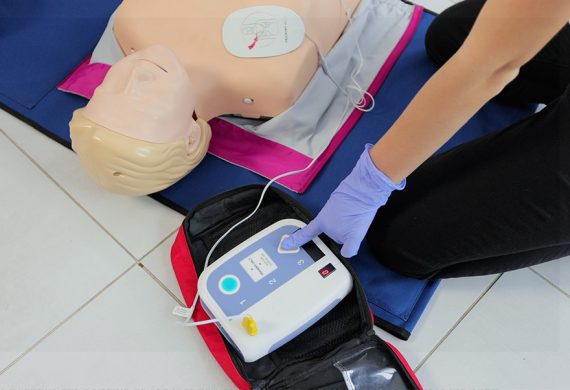
- Place one pad on the right side of the chest, just below the right collarbone. Apply the other pad just below and to the side of the left nipple.
- Once the defibrillation pads have been applied, follow the regular defibrillation procedures. Plug in the connector and ensure that no one is touching the casualty when the AED is analysing heart rhythm.
For Women

The placement of defibrillation pads does not differ for female casualties.
- Roll up the casualty’s shirt or use the scissors in the AED kit to cut away any clothing that hinders the process.
- Place one electrode pad on the casualty’s upper right chest under the collarbone, and the other electrode pad on the lower left side under her left breast.
- You can cover her up with her shirt after the AED pads are placed to protect her modesty.
If there are other people around, we can also get them to form a human shield, facing outwards, to block the view of passers-by.
For Pregnant Women
Maternal cardiac arrest is rare. When such cases occur, steps to perform CPR and apply AED on the pregnant victim are the same as on a woman.
Performing these lifesaving techniques on a pregnant woman in cardiac arrest gives not just her, but the fetus a chance of survival.
For Cardiac Arrest Victims with a Pacemaker
Pacemakers regulate heartbeats when it detects any sign of arrhythmia. However, defibrillation is still necessary for cardiac arrest victims with a pacemaker as the device is not able to regulate VF.
To identify if the cardiac arrest victim has a pacemaker, look for a small bulge on their upper chest or abdomen.
If the casualty has a pacemaker or an implantable cardioverter-defibrillator (ICD), place the AED pad four fingers away from it.
For Children and Infant
AEDs can be used on children aged one year or older. Pediatric pads are preferably used for children below eight years old. Most AEDs come with pediatric pads. However, in an emergency where they are not available, an AED with adult pads can be used on children and infants as well.
The AED pads placement for children and infants does not differ from the adults. Defibrillation pads should be placed in the anterior lateral position, i.e. on the upper right chest and to the side of the left nipple. Ensure that the defibrillation pads do not touch and are at least 1-2 cm apart.
Pads placement on the chest is ideal for optimal defibrillation to occur. However, if the pads are touching, place the pads in the anterior-posterior (chest and back) position.


In the anterior-posterior pad placement, apply the right pad at the front of the chest, on the central sternum. Carefully turn the child or infant and apply the left pad on the upper back, between the shoulder blades. After the defibrillation pads have been applied, lay the child or infant on their back and proceed to follow the steps of using an AED.
How to Use an AED
After placing the defibrillation pads, follow the steps below.
1. AED analysing
When the AED starts analysing heart rhythm, no one should touch the casualty. Spread both arms out and shout “Stay Clear”.
2. When the AED prompts:
- Shock advised
- Shout “Stay Clear”
- Ensure no one is touching the casualty before pressing the shock button.
- After shock is applied, resume chest compressions, and follow the AED prompts.
- No shock advised
- Resume chest compressions and follow the AED prompts.
Stop CPR only when the AED is analysing heart rhythm, when the casualty wakes up or regains normal breathing, or when the paramedics take over.
Know More About AED
Defibrillation pads can only be used once and must be replaced along with other supplies used after an emergency or when they expire. Generally, AED pads have a validity of 3 to 5 years before they expire.
AED owners are encouraged to schedule regular AED maintenance checks to ensure the machine is well-maintained and rescue-ready.
Download our handy guide to learn more about AEDs.
Learn CPR+AED
The use of AED alone is insufficient to save a life. Both CPR and AED are key to the victim’s chance of survival. While formal training is not needed, familiarising yourself with these lifesaving techniques can prepare you for cardiac emergencies.
Learn the basic steps to perform CPR and use an AED at our non-certification course for general learners. We also conduct certification courses for advanced learners and professionals.
You can also check out our guide on the basic steps to CPR and AED.
Conclusion
Using an AED is simple. Follow the general principle of keeping the chest bare, clean and dry before defibrillation and ensure the defibrillation pad is placed in the correct position. If you are unsure where to place them, follow the visual guides on the pads. Remember these steps and you too can save a life!