|
National Life Saving Day 2026: Life Above All in a Super-Aged Singapore
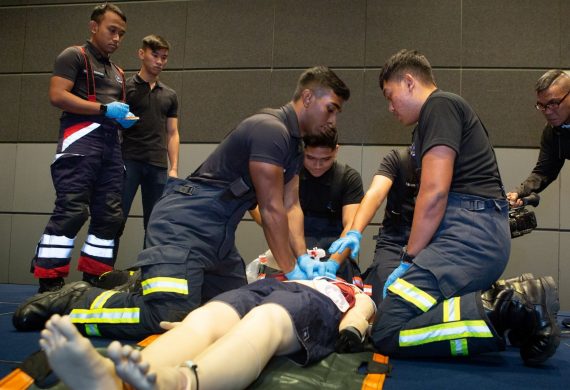
- There is a need to train more caregivers in life-saving skills as the risk of out-of-hospital cardiac arrest increases in a super-aged society.
- Some professional caregivers who are more likely to face the challenge of a cardiac emergency and community first responders may be hesitant to save a life, on the concerns of the potential legal implications surrounding the Advance Care Planning and Advanced Medical Directive arrangements of the casualties.
- Individuals who act in good faith to save a life will be protected under the law and they should always put life above all in a cardiac emergency.
Singapore, 17 January 2026 – As Singapore becomes a super-aged society in 2026, with more than one in five Singaporeans expected to be 65 years old or older, and one in four Singaporeans will be aged 65 or above by 2030, the incidence of out-of-home cardiac arrest (OHCA) is likely to increase exponentially.
Currently, close to 80% of OHCA cases occur in residential and public settings, outside healthcare facilities, and research has shown that those above the age of 65 face the highest risk of OHCA. These statistics imply that it will be increasingly important for members of the public, especially professional caregivers, to be trained in CPR and AED skills and be empowered to act decisively in a cardiac emergency.
National Life Saving Day 2026 Spotlights Preparedness for Elderly Cardiac Emergencies
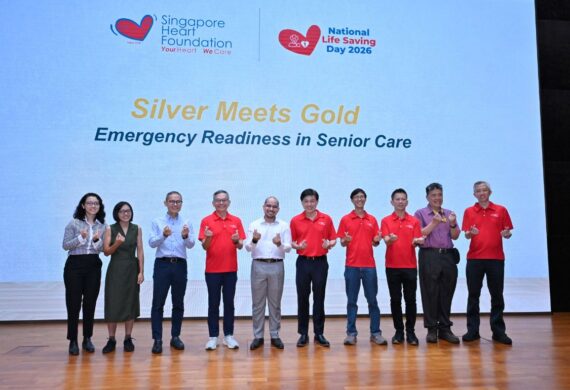
Organised by the Singapore Heart Foundation (SHF), the National Life Saving Day 2026 (NLSD 2026) event was themed “Silver Meets Gold: Emergency Readiness in Senior Care”, and it focused on how both professional caregivers and community first responders can prepare for cardiac emergencies involving seniors, while also addressing the legal and ethical considerations surrounding Advanced Care Planning (ACP) and Advanced Medical Directive (AMD) arrangements in a rapidly ageing society.
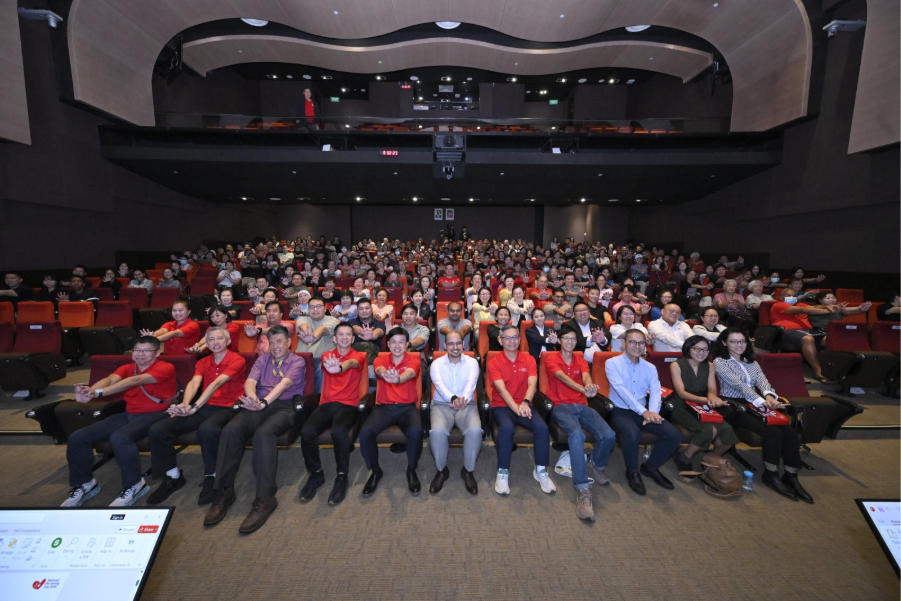
The event, held at the Ngee Ann Kongsi Auditorium at the Academia @ Singapore General Hospital, was graced by Guest of Honour Dr Syed Harun, Senior Parliamentary Secretary, Ministry of Education and Ministry of National Development, and was attended by various professional caregivers from the nursing homes and active ageing centres under the Agency for Integrated Care, as well as private home care agencies.
A Super-Aged Society Calls for More Lifesavers
With the fast-greying population and the elevated risk of sudden cardiac arrest that follows, neighbours, passers‑by, and notably, professional caregivers, are often the first or only community first responders who are the lifeline for the elderly, before the emergency medical services crew arrives. This makes CPR and AED skills critical for the survival of these senior casualties.
Professor Ching Chi Keong, SHF’s Honorary Secretary and Chairperson of the Heart Safe Committee emphasised: “When a sudden cardiac arrest occurs, rescue efforts during the next four minutes are the most crucial. This determines if these seniors walk out of the hospital in good shape, suffer irreversible brain damage, or never go back home at all. Caregivers and members of the public can play an important role by equipping themselves with CPR and AED skills and rising to the occasion without hesitation. With that, we can make every elderly care institution, home and community space in Singapore a heart safe place for our seniors. Saving a life should always be above all.”
Potential Legal Complications Plague Some Good Samaritans
Despite the public-spirited nature of a life-saving act, some professional caregivers as well as trained members of the public may hesitate to intervene when a cardiac emergency occurs, due to concerns over the potential legal implications arising from ACP or AMD.
In some instances, rescuers had to face legal uncertainty after resuscitating casualties who had formally expressed a wish to not be resuscitated. Such fears can pose a daunting hurdle to timely intervention, resulting in the loss of precious lives.
Dr Joanna Chan Shi En, Emergency Medicine Consultant at the Singapore General Hospital, who is also one of the event’s speakers, opined: “Every second counts when responding to a medical emergency. In situations where a patient’s medical history is unknown, such as outside a healthcare facility, trained first responders must be able to act quickly to save a life without fear or hesitation. It is important for them to know confidently that when they perform CPR or use an AED on a casualty in good faith and with reasonable care that is proportionate to their skills and experience, they are acting responsibly, ethically and are protected by the law.”
Save a Life Without Second Thoughts
Ms Nora Binte Salleh, Head of Nursing at Active Global Home & Community Care, provider of home and centre-based care services said: “In our line of work, cardiac emergencies involving elderly patients are a common occurrence. Regardless of any ACP or AMD arrangements, our position — and that of our professional caregivers — is always to save life to the best of our abilities, without hesitation or reservation. We believe that every caregiver represents a vital link in the chain of survival.”
Even though there is no Good Samaritan law in Singapore to protect first responders who voluntarily provide assistance to a casualty during a medical emergency from legal liability, individuals should always be assured that they will not be penalised under the law if their act to save a life was performed in good faith and with reasonable care.
It is only when everyone is trained and ready to save a life without fear or hesitation that Singapore can become a truly heart safe nation for all Singaporeans!
For more information about the event, please visit: https://www.myheart.org.sg/events/national-life-saving-day/.